

I’ve never seen anything like it
In twenty-seven years of doing this work, I’ve never come across a technology that has this many people feeling like experts in it.
Some do know a lot. Some really don’t. Most really don’t. And the interesting question isn’t who’s who. It’s why. Why this one? Why does AI, more than anything I’ve watched arrive in nearly three decades, hand so many people the feeling of mastery?
The answer turns out to be sitting in the data, and it’s worth a look before we go on.
Nobody was taught this
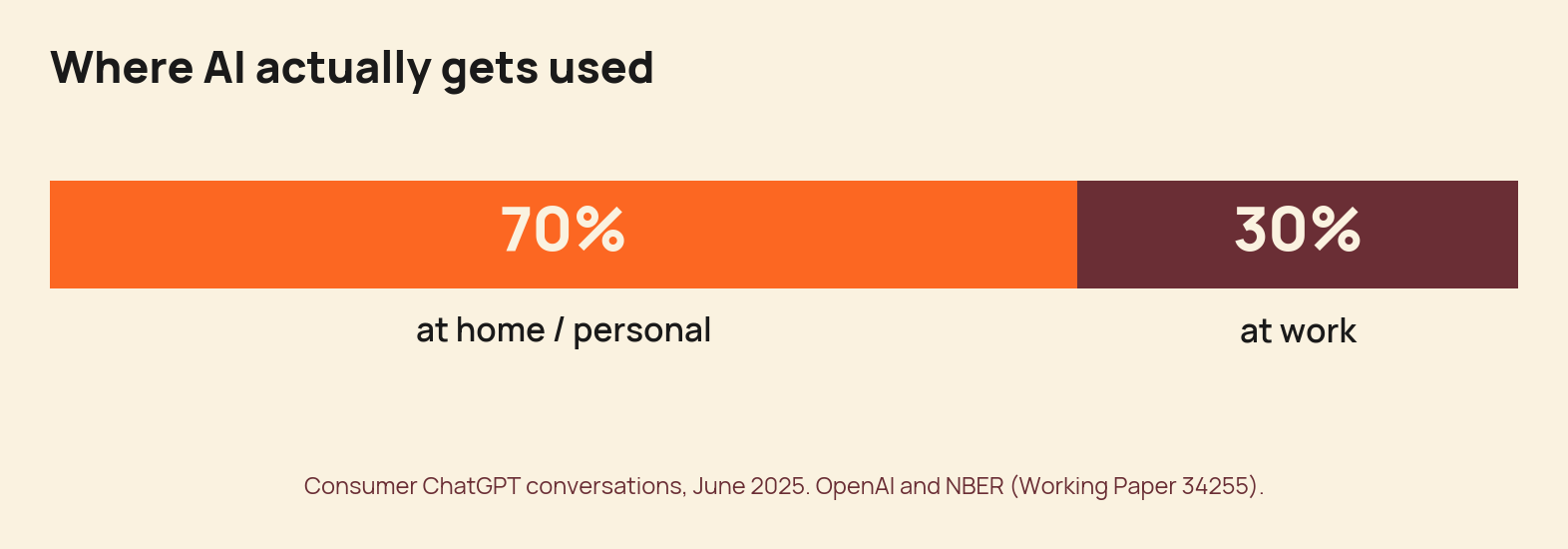
Where do people actually use AI? Mostly at home. The biggest study of it so far, an OpenAI and NBER paper covering 1.5 million conversations, found that personal use has climbed from 53% to more than 70% of all use in a year, and it’s still growing faster than work use. The revolution is happening on the couch, not at the desk.
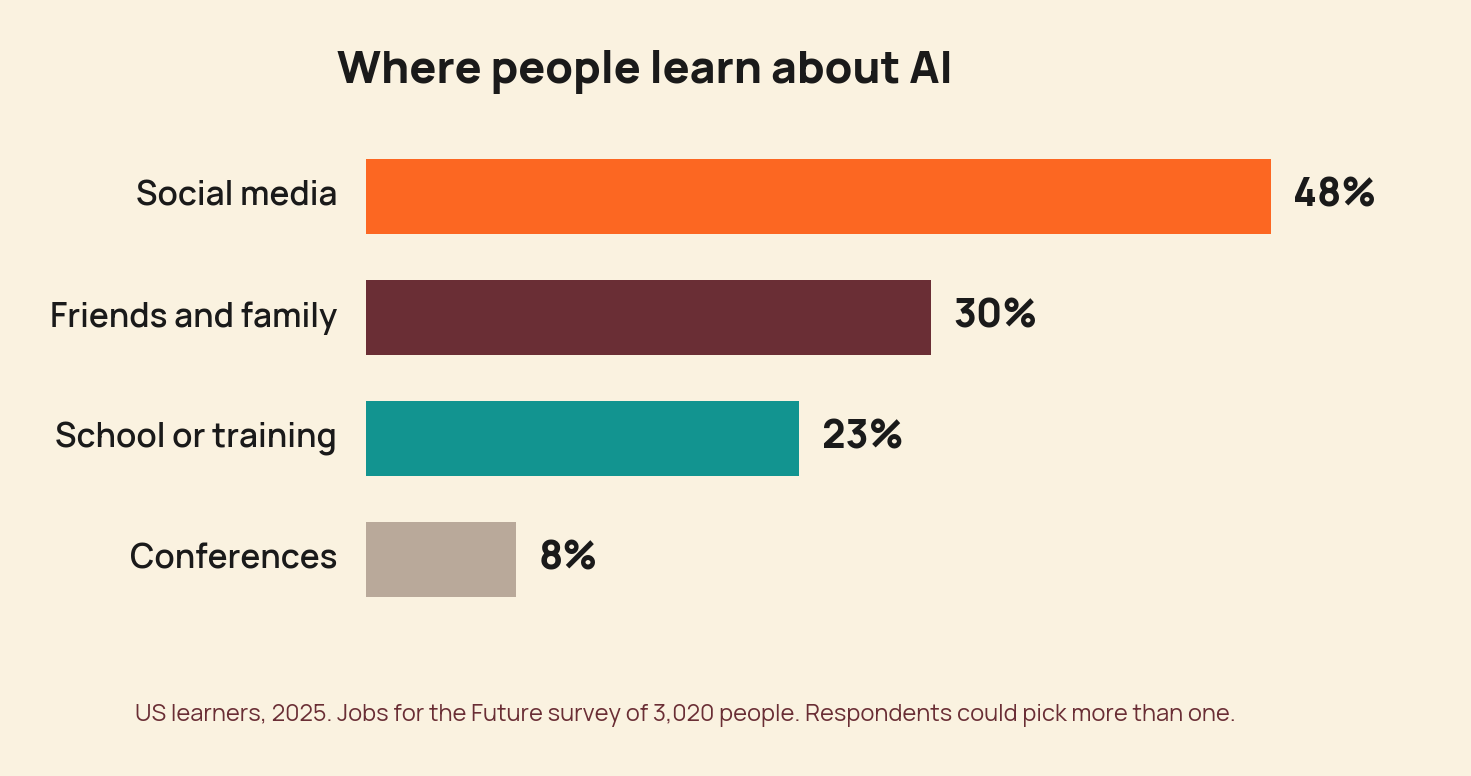
And where do people learn it? Almost nowhere formal. A 2025 US survey by Jobs for the Future found people are more likely to pick up their understanding of AI from social media, news and friends than from any school or training. Social media 48%. Friends and family 30%. Their actual school or training program, 23%. On top of that, half are just experimenting on their own, and another 44% are learning off YouTube. At work it’s no better. Only about a third of workers say they’ve got the training they need, and more than half say their employer has never once asked them how they use it.
The US figures are US figures, so take the exact numbers as a sketch rather than gospel for here. But the shape travels, and it raises the question that is the whole point.
If that’s where everyone learned it, what is everyone’s understanding actually built on?
The mother of all assumptions
Assumption. That’s the answer. Not instruction, not experience. A picture absorbed off a feed, from a mate, in a headline, and then carried around as if it were knowledge.
That’s why the expert feeling is everywhere and the actual expertise is rare. A clip transmits the swagger and skips the substance. You watch someone get a slick result in thirty seconds and you absorb the confidence without any of the work underneath it. AI, the mother of all assumptions.
And once you see it that way, you start seeing it everywhere. Let me sketch three kinds of people I keep running into. This won’t cover everyone, it’s my own lived experience, roughly and probably unfairly summarised. But it’s three faces of the same thing.
Three people, one assumption
There’s the friends and family group. The backlash. On a personal level I actually get more pushback than enthusiasm. Plenty of people don’t like the idea of AI at all, and very few will admit it when they have used it. They’ve decided what it is and turned away. The thing is, that decision got made off a secondhand picture, the feed, the headline, the dinner-table chat, not off actually using it.
There’s management and above. And I want to be careful here, because these are not stupid people, they’re swamped ones. The opinions are polarised and both poles are unrealistic. One pole assumes it’s close to magic and will transform the business if they just hand out the licences. The other doesn’t think it’s nothing, nobody thinks it’s nothing. They see it as an added complication. An unknown ingredient on a very full plate, with real edges, compliance, data leakage, privacy. So they make the rational-looking call and park it. The perfect thing to defer and not deal with. But “park it” is an assumption too, that it’s safe to wait, and it’s made without the firsthand experience that would let you weigh that properly.
And there’s the worried workers. Maybe a third of people, using it more or less blind to get the work done. Frightened for the job, so heads down, not learning to drive the thing, just using it and hoping. Assuming it’ll save them, or assuming it’ll replace them, and either way leaning on it without understanding it. Dangerously believing every LLM whisper in their ear.
Three groups, three assumptions. Not one of them got their picture from being taught.
The couch in the boardroom
Here’s the part that gets me, and I think the data quietly backs it.
It feels like all three of those people are, underneath, the same person the studies describe. The home learner. The one who picked AI up socially, off a feed, rarely taught. The family member who turned away from it mostly formed that view at home. The executive parking it, often off headlines rather than from inside the business. The worried worker, who likely met it at home too, then brought it to work.
Few of them learned it where they’re now making the call. They learned it on the couch, and they’re deciding in the boardroom. The boardroom assumption looks a lot like a living-room assumption wearing a suit, and the picture doesn’t always upgrade on the way in.
That, to me, is the mother of all assumptions, fully grown. Not just that people assume. It’s that a lot of the thinking now steering real business decisions about AI seems to have been formed in the lowest-stakes, least-structured place there is, then carried more or less unchanged into the highest-stakes one.
So how do you actually fix it
Here’s where I’d love to hand you the answer, except the honest one is uncomfortable.
Don’t learn it from social posts, then. Do a course. Sift the noise yourself until you find what’s actually going on. Fine, except all of that runs into one wall: this thing moves at a pace nothing can keep up with.
Last night I watched a video about a new feature on an AI platform. The presenter said it was great, and added that they wished one more thing were possible. The first comment, laughing, said it already was, just look in the menu on the left. Four hours from release to stale. That’s the speed. No course survives it. No “complete guide” stays complete past lunch.
So I’ll concede the thing nobody wants to concede. Given that pace, social is probably the most realistic way for most people to keep up. The clips win, not because they’re good, but because they’re the only thing fast enough.
The long way is the only way
But there is another way out, and it isn’t a short-term one.
People will find their feet over time, the way I did. Not by reading about it. By doing it. Getting it wrong, learning the lessons that only come from use, working out what actually matters to them and choosing where to spend their attention. Then investing the time in those parts and reaping what they learn. That’s not a weekend course. It’s a slow shift from assumption to experience, one person at a time.
I’d love it to happen sooner. It would make doing business an awful lot easier. But I know it’s a way off.
So until then, I give a thumbs-up on every clip anyone sends me. And recently two of those clips had genuinely useful things in them, and I was thankful to get them. Twenty-seven years in, and I’m still standing in the same stream as everyone else, taking the good ones gratefully. That’s where we all are right now. The best thing you can do is know that’s where you are, and stay honest about the picture you’re carrying.
If working out what’s actually worth your attention in all this would help, that’s a good conversation to have.
Garth Shoebridge is a digital problem-solver with 25 years of experience helping South African businesses think clearly before they build. If this is the question on your desk right now, start with a conversation.